
Blog · SEO
SEOWhat AI Overviews are actually doing to organic traffic
Three months of data from accounts we manage, broken down by query intent. The headlines about “AI is killing SEO” miss the part where the impact splits cleanly by what users were searching for.
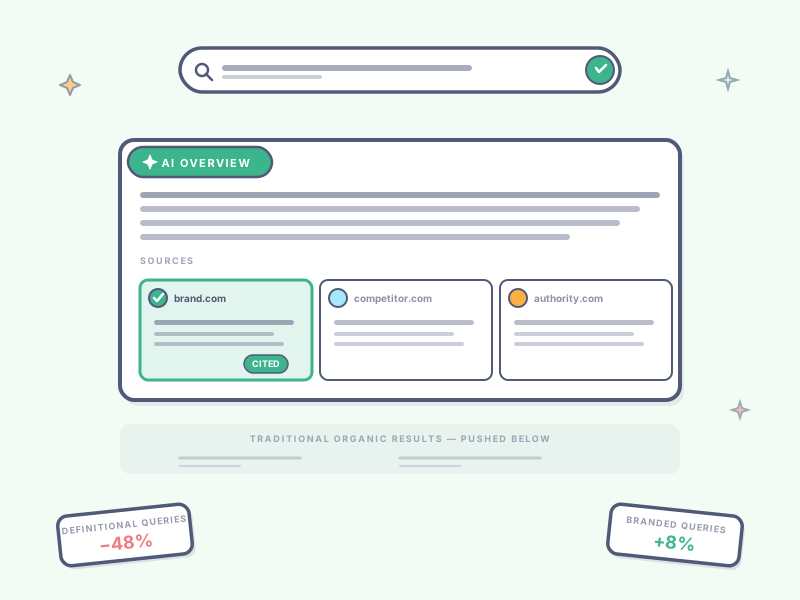
“AI is killing SEO” is the wrong headline. The right headline is that AI Overviews are killing some queries while leaving others untouched, and the split is more predictable than the panic suggests.
For the past three months we’ve been tracking organic traffic across the accounts we manage, broken down by query intent. The data is consistent enough that the pattern is now load-bearing in how we plan content roadmaps. Here’s what’s actually happening.
The split: definitional traffic down, branded traffic up, commercial traffic mixed
Aggregate organic traffic is misleading. Looking at “organic sessions, all queries” obscures four distinct effects happening simultaneously. Once you segment by query intent, the picture clarifies fast.
Definitional queries: −40% to −55%
“What is X” / “how does Y work” / “definition of Z” — anything where the user’s task is to get an answer they don’t need to click through to. AI Overviews are now satisfying these queries in the SERP itself. The user reads the AI-generated answer, possibly checks one or two citation sources, and never visits the underlying pages.
This is the cohort where the panic-headline writers are technically correct. If your blog is mostly definitional “ultimate guide to [topic]” content, your organic sessions are down significantly. If you’re a publisher whose business model depends on display ad revenue from definitional content, the AI Overview era is genuinely an existential problem.
Most B2B and DTC brands aren’t in that category. Their commercial revenue doesn’t come from definitional traffic — it comes from buyers further down the funnel. The loss of definitional sessions is real but doesn’t directly cost revenue if you weren’t monetizing those sessions in the first place.
Commercial / vendor-evaluation queries: −5% to +15%
“Best X for Y” / “X vs Y” / “[competitor] alternatives” / “[product category] pricing” — buyer-research queries where the user wants to evaluate options. These are partially affected by AI Overviews (which now sometimes summarize “the top three options”), but the AI answer rarely satisfies the underlying task. Buyers evaluating a $40K SaaS purchase or a $300 ecommerce decision still click through to compare features, read reviews, and see specifics.
This is the cohort where positioning matters most. Brands cited by AI Overviews as one of the top options gain traffic. Brands not cited lose it. The volume effect is modest in either direction (we’ve seen swings of ±15% on a per-query basis), but the compositional shift toward “AI-cited brands” is real and accelerating.
Branded queries: +5% to +12%
“[brand] login” / “[brand] pricing” / “[brand] reviews” — users searching for you specifically. These are slightly up, and the mechanism is interesting: AI Overviews are exposing branded names to category researchers who then search those names later. We’re seeing branded query volume rise across accounts that have invested in AI Overview citation discipline. The effect compounds — the more AI-cited a brand is, the more its branded search volume tends to grow.
Transactional / high-intent queries: roughly flat
“[product] free trial” / “[brand] demo” / “buy [product]” — users ready to convert. AI Overviews almost never interfere here. The buyer’s task is to find your product, not to research a category. Traffic to these queries has held steady across the accounts we manage.
What this means for content strategy
The honest answer: the kind of SEO content that worked in 2022 has a meaningfully smaller payoff in 2026. Big definitional pillar pages designed to capture “what is [category]” traffic and monetize via newsletter signups are a worse investment than they were two years ago. The traffic still exists at the top of the funnel, but more of it now never leaves the SERP.
The kind of SEO content that’s working better than ever: commercial-intent pages, comparison pages, and named-expert authority content that AI systems are likely to cite. The shift isn’t “SEO is dead” — it’s “SEO has reweighted toward the parts of the funnel that produce revenue.”
Three structural moves we’re making across accounts:
- Cutting definitional content production. Not deleting existing pages (the residual traffic still has some value), but stopping the production of new top-of-funnel definitional content unless it directly supports a commercial-intent target. The marginal definitional post is no longer earning its production cost.
- Doubling down on commercial-intent content. Comparison pages, “best X for Y” pages, alternative-to pages, pricing transparency pages. These are the queries where the AI Overview era hasn’t materially reduced click-through, and they convert better than top-of-funnel content does anyway.
- Building for AI Overview citation explicitly. FAQ schema on every commercial page. Structured answer blocks in the first 150 words of every pillar. Named expert content with author credentials and byline schema. AI systems index named-expert quotes from authoritative sources heavily, so getting your subject matter experts into editorial coverage on trade publications is now a measurable ranking input.
How to measure your account’s actual exposure
Segment your organic traffic by query type before drawing conclusions. The two reports we run monthly:
Query intent breakdown. Pull your top 200 ranking queries from Google Search Console. Manually tag each as definitional / commercial / branded / transactional. Sum impressions and clicks by category. Compare month-over-month change by category, not in aggregate. The aggregate number hides everything; the categorical breakdown shows you what’s actually moving.
AI Overview citation tracking. Pick the top 30 commercial-intent queries you care about most. Manually search each one (in incognito, with your VPN set to your primary market). For each, note: does an AI Overview appear, and if so, is your brand cited in the sources? Track monthly. We’ve found this is the single most useful piece of SEO reporting we run right now, and it doesn’t yet have a good automated tool.
The accounts where AI Overviews changed everything
The DTC pet wellness account we wrote about in this case study grew organic sessions 3x and revenue 5.9x in the AI Overview era — by leaning hard into pillar-and-cluster content with strong AI citation discipline. The same account would have grown maybe 50% if we’d kept producing definitional content and ignored the citation game.
The structural insight: AI Overviews didn’t reduce the value of being good at SEO. They reduced the value of being good at one specific kind of SEO (definitional content for top-of-funnel monetization) and increased the value of being good at another (commercial-intent content that gets AI-cited).
Reweight your content investment accordingly. The category isn’t dying. The tactics are.
Want a second opinion on your AI Overview exposure?
Our SEO team audits organic traffic by query intent and shows you exactly which segments of your content are being eaten by AI answers versus which are still earning revenue.
Get your free audit →
Written by
Maya Okonkwo
SEO Lead
Maya leads SEO at AgencyName. Background in technical and content SEO for marketplace and SaaS at scale.
Get the weekly playbook
One actionable marketing tactic, every Tuesday. Read by 50,000+ marketers.
Unsubscribe in one click. No spam, ever.
Ready for a marketing plan that hits?
Free. No obligation. 48-hour turnaround.