
Blog · Strategy
StrategyHow we allocate budget between paid and organic across stages
The right paid-to-organic ratio shifts as the business grows. We have run the math on dozens of engagements and the pattern is consistent enough to be useful as a planning input.
Founders ask us this question more than any other. “What’s the right split between paid and organic?” The honest answer is that the right split changes — and the way it changes is one of the more consistent patterns we see across the engagements we run.
Here’s the framework.
The three-stage allocation pattern
Stage matters more than category. We’ve run this framework on DTC ecommerce, B2B SaaS, B2B services, and healthcare. The specific channel mix inside the paid bucket changes by category (paid social dominates DTC, paid search dominates B2B). The paid-versus-organic ratio holds across categories at each stage.
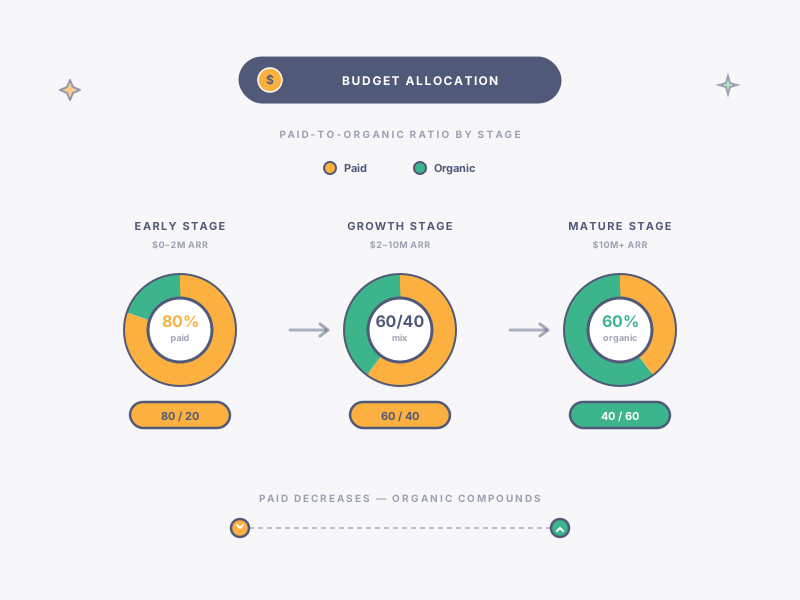
Early stage ($0–2M ARR): 80% paid, 20% organic
At the early stage, you need fast signal. Paid gives you fast signal. Organic gives you compounding signal, but compounding doesn’t start meaningfully producing until month 6+ and doesn’t pay back the investment until month 12+.
If you’re under $2M in ARR, you don’t have the runway to wait 12 months for organic to compound. You need to find out what works in your category right now, what positioning resonates, what ICP converts. Paid does all of that in 60 days. Organic takes a year.
The 20% organic allocation at this stage isn’t wasted — it’s invested in the structural foundation (technical SEO basics, a small content calendar, brand search defense) that lets organic compound later. But it’s not where the growth lever lives.
Common mistake at this stage: founders read a “SEO compounds forever” article and over-invest in organic before paid has produced the buyer-learning data that should inform what content gets written. Building content for a positioning hypothesis you haven’t tested in market is the most expensive way to do SEO.
Growth stage ($2–10M ARR): 60% paid, 40% organic
The transition stage. You’ve validated your ICP, your positioning works, paid is hitting consistent unit economics. Now organic starts earning its weight.
The shift from 80/20 to 60/40 happens gradually over roughly 18–24 months. The mechanism: organic content built in the early stage starts ranking, traffic compounds, and the cost per acquired customer from organic drops below paid’s cost per acquired customer for the same ICP. When organic CAC crosses below paid CAC for comparable buyers, marginal dollars start moving from paid into organic.
This is also the stage where the integration thesis we wrote about in this case study starts mattering structurally. With both channels running at meaningful scale, the question stops being “which is better” and becomes “how do we make them compound together.” One strategist owning both channels with budget authority to shift between them based on shared intent data is the move that separates the brands that grow efficiently at this stage from the ones that plateau.
Mature stage ($10M+ ARR): 40% paid, 60% organic
At maturity, the structural shift completes. Organic is now your dominant acquisition channel by volume, with paid playing a precision role — capturing high-intent commercial traffic, defending branded search, and accelerating launches.
The unit economics at this stage are dramatically better than at the early stage. Organic-acquired customers cost meaningfully less to acquire than paid-acquired customers, branded search (driven by organic discovery and AI Overview citations) converts at multiples of unbranded paid, and the compounding effects of content built years earlier are still producing traffic without ongoing investment.
The 40% paid allocation isn’t a reduction in absolute spend — it’s a reduction in proportional weight. Paid budgets at mature stage are usually larger than at any prior stage in absolute terms, but they represent a smaller share of total acquisition because organic has grown faster.
The exceptions worth naming
The pattern holds, but four conditions can shift the optimal ratio meaningfully. None of them invalidate the framework; they shift where on the curve you sit.
Vertical-specific demand patterns
Some categories have inherently more organic demand than others. SaaS for finance, marketing, and HR has high commercial-intent organic search volume — buyers actively research before purchase. SaaS for niche operational categories (e.g., field service management, manufacturing ERP) has much thinner organic demand; buyers don’t search “best field service management software” the way they search “best CRM.” Categories with thin organic demand stay paid-heavy longer than the standard curve suggests.
Sales cycle length
Long sales cycles favor organic. A 9-month B2B sales cycle creates 9 months of decision-stage content consumption per buyer — that’s territory where bottom-of-funnel comparison content earns its keep. Short sales cycles (DTC impulse purchases, B2B PLG sign-ups) favor paid because the buyer journey doesn’t have a deep research stage where organic content earns weight.
Brand strength
Strong brand recall accelerates organic. If your brand has meaningful recognition in your category, branded search compounds faster — every paid impression creates a future branded search, and branded search is where organic shines. Weak brands need more paid for longer because they don’t have the branded-search tailwind.
Category maturity
New categories favor paid (you have to teach the market that the problem exists before they search for solutions). Mature categories favor organic (the problem is understood, buyers search systematically). If you’re creating a category, the standard ratio doesn’t apply until the category is established enough for organic demand to exist.
The decision rule, simplified
If you want a single decision rule rather than a framework:
Move marginal dollars from paid to organic when organic’s customer acquisition cost drops below paid’s for comparable buyers.
That’s it. The 80/20 → 60/40 → 40/60 progression is the typical pattern this rule produces, but the rule is more durable than the ratios. If your organic CAC stays higher than paid CAC longer than usual (because your category has thin organic demand, or your sales cycle is short, or you’re early in the curve), you stay paid-heavy longer. If your organic CAC drops below paid CAC earlier (because your category has rich organic demand, or your sales cycle is long, or you have brand tailwind), you shift to organic-heavy sooner.
The mistake is treating the ratio as a fixed input. The ratio is the output of where you sit on the CAC curve. Run the math monthly; let the ratio fall out of the data.
What to do this quarter
Three concrete moves:
- Calculate CAC by channel, weighted by buyer LTV. Not CAC by channel in aggregate (that hides too much), and not CAC by campaign (too noisy). CAC by channel, weighted by the LTV of the customers each channel brought in. This single calculation, run monthly, tells you whether your current ratio is correct.
- Compare your current paid-to-organic split to the stage benchmark. If you’re at $5M ARR running a 90/10 split, your underinvestment in organic is probably costing you medium-term CAC. If you’re at $1M ARR running a 50/50 split, your underinvestment in paid is probably costing you growth velocity.
- Set the budget shift target for the next 12 months, not just the next quarter. Moving from 80/20 to 60/40 isn’t a quarterly decision — it’s an 18–24 month gradient. Plan the trajectory, not the next budget cycle.
The framework isn’t prescriptive. It’s a starting point with consistent enough patterns to be useful as a planning input. The right split for your business is the one your CAC math produces. The job of this framework is to give you the right question to ask of your data.
Want a second opinion on your channel mix?
Our strategy team runs the CAC-by-channel math and shows you where your current allocation is leaving money on the table.
Get your free audit →
Written by
Taylor Brooks
Head of Strategy
Taylor leads cross-channel strategy and helps clients allocate budget across paid, organic, and email.
Get the weekly playbook
One actionable marketing tactic, every Tuesday. Read by 50,000+ marketers.
Unsubscribe in one click. No spam, ever.
Ready for a marketing plan that hits?
Free. No obligation. 48-hour turnaround.